Tuesday, September 15, 2015

“My First International Day of yoga Conference “experiences Jun 21 st and June 22nd 2015

“My First International Day of yoga “experience Jun 21 st and June 22nd  2015

 DAY ONE ARRIVAL - THE HOTEL ASHOKA, Chanayakpuri, New Delhi
As an initiative by our Indian PM Modi Yoga day was formed and recognized by the U.N to promote the Physical mental and spiritual discipline that is yoga in a right manner as a science of India. Being a yoga practitioner and Guiding and helping people come out of their stress related disorders in the Wonderful city of Oman for over 20 years, I was delighted to be called upon as a representative from Oman along with another expert from Oman, for the world’s first ever international yoga day celebrations.
On the 20th of June 2015 I had reached our capital city, Delhi and along with yoga gurus from Sweden, America, Malaysia and rest of the world was welcome with great pomp and splendor , with an individual guide, translator (for those who needed it)and security . We were accommodated in Hotel Ashoka as guests and Delegates, arrangements was for young children from the local schools representing the next generation of Yogis.
Apart for the greeting being fantastical organized it was great to see how widespread yoga has become in the world and how many different forms it has taken on, some have been modified/innovated to help people with health issues.


THE FIRST DAY OF CONFERENCE JUNE 21ST 2015
Next day being declared as international day of yoga our pm Modi ji had conducted yoga session in Rajpath and made it to the Guinness Book of World Records for the largest yoga demonstration at a single venue with 35,985 people participating.

We set off for the conference, dressed in our finest traditional clothes, The hotel lobby soon became a colorful mélange of the diverse clothing traditions of India and the rest of the world, even the Yogis from the west were dressed in Punjab styled kurtas and payjamas. From there we went by bus with our security detail to the avenue at the Vigyan Bhawan New Delhi.

The guests were sent by a single bus, during the journey it was wonderful to learn from the other gurus about how yoga has evolved in their home countries. Along the way the Delhi monsoon decided to welcome us, being from an arid and dry country, we were delighted to experience this downpour, but for those from the cooler climates this proved to be an inconvenience. Once we reached the venue due to security reasons we have to walk from the gate to the main hall, as this was still raining we had to rush like little schoolchildren from the gate to the main hall; fortunately we didn't get too wet. Once we reached the main hall, we were greeted and seated in the hall which was stylized in the manner of the Indian parliament hall in the 6 th row with our country name mentioned on desk.

First there was a speech from the Prime Minister Mr. Narendra Modi, he beautifully explained how Yoga is a part of the Indian essence and traditions and with the modern times it’s being adopted by the west and being forgotten here at home and how now there is a need to unify the different branches that have come up and redefine it as a modern, verified and accredited science.
 For this purpose he has formed The Ministry of “AYUSH” Ayurveda, Yoga and Naturopathy, Unani, Siddha and Homoeopathy.

After him there was a few keynote Speeches on their respective sciences and practices by Swami Ramdevji (founder of Patanjali Yog peeth, Haridwar), 

  Dr Veerendra  Heggaadeji (Dharmadhikari of Sri kshethra Dharamshthala)
  Proff H.R Nagendra ( chancellor of swami Vivekananda Yog Anusandhana Samsthana)and Naik (Minister of State for AYUSH).
After this and gifting of the commemorative coins and postage stamps by the honorable prime minister, the rest of the day was spent in discussion and debating among the participants and the committee chairs on the different branches of yoga what would constitutes as a new technique and what would not, what parameter should one fulfill to call him/herself a yoga teachers, how research and grants for research should be carried out and the creation of new schools to retrain and provide the next generation with trained and certified yoga teachers.
The objective session is to provide an insight in to the traditional basis of yoga and it relevance in the present day context.

Many other experts in technical sessions were Dr.David Frawley(Vedic origin of Yoga) founder and director of American institute of Vedic studies, Dr Parimal Devanath and  chairpersons were Hansaji Jayadeva Yogendra (Director of YOGA Institute  Santacruz Mumbai) and  Meenakshi Devi BHAWANI..few others.


2nd day of conference in Vigyan Bhawan
As we came the second day to Vigyan Bhawan which was s much easier to enter as formalities were less and security was less.

“Vasudhaiv Kutumbakam”whole world is my family is the Indian philosophy.
Yoga is to play main role in peace harmony and spiritual elevation across the world.
To share this Rajyogini Asha Didi and Shri Satpal singh were Co-chairpersons followed by Aacharya Bal Krishna (companion of baba ramdev ji) and other technical sessions were shared by Yogini Shambhavi Devi (Yogini Shambhavi Devi is a spiritual guide and educator rooted in the ancient teachings and Vedic traditions of Tantra, Jyotisha, Ayurveda and Vedanta.)
Living traditions of Yoga have not only kept this ancient practice alive but also immensely contributed in customizations of Yogic practices to suit the day to day activities conducted by Swami Maheshwarananda (has his own ashram in Rajasthan )


Surprisingly after this at the end of the day we were asked to close the day with yoga delegates from different countries to share our teaching in their respective country. Given an opportunity and not to miss this spoke few words thanking Oman’s Ruler his Majesty Sultan Qaboos Bin Syed for his support always for being so generous and freedom to think and follow our yoga practice, for the welfare of people in country. I am always grateful and my sincere gratitude towards him.

 I also shared the Hatha Yoga techniques which I follow and how much importance I give for correct breathing in day to day life for everyone to combat stress. I expressed my feelings towards this event, By sharing that how I felt honored to be part of this historical event due to our Prime Ministers Initiative and we are thankful that he gave us chance to share our knowledge and to get more knowledge with different experts in this field. I’m sure to contribute in this field till end and make sure our PM dream of better world with better peace and harmony come soon.


We as team will work towards his higher dreams as I always believe” DREAM WORKS ONLY WHEN TEAM WORKS”.


Before the final show of special guests I requested AYUSH to allow me to present the ministry with an album which contained all the activities which myself and my students got an opportunity to develop towards this country Oman  for 20 years .


There was in the end valedictory ceremony for those who completed the first yoga teacher training course under AYUSH.


There were experts like Sadguru Jaggi Vasudev, Brahmakumari Shivani ji and Home Minister Rajnath Singh who Honored this closing ceremony. It was feast to hear Sadguru and Shivaniji’s talk on life.

Rajnath singh shared an excellent speech as yoga not a religion as it is to unite and not to divide and every religion has Yoga in it and as it involves awareness, peace and harmony.
And we were in the end taking life time experience and returned back to hotel Ashoka. Next day we all departed to our own respective countries taking back many sweet memories and learning experience of life time. I consider myself very fortunate to get this opportunity.

Hari Om Tat Sat

Tuesday, December 16, 2014

Yoga for Senior Citizens!!


We all grow up but it’s only by choice we get to age gracefully!! As one’s body ages simple tasks such as climbing a flight of stairs, a quick jog around the park, tying your own shoes or even something as simple as sitting cross legged on the floor for a small about of time become a herculean task, now for most the minute these small tasks become difficult the logical human decides that the best course of action would be to accept it as a part of ageing and avoid those activities altogether. 

Unfortunately the logic is flawed and reverse is the better way to go about aging gracefully as with the right diet and exercise an older person can sometimes be even more fit than a youngster!!

An excellent way to ease into an exercise routine at an advance age is through yoga, as the benefits (especially for a mature person) include an increase in muscle tone ( lost over the years ) ,improvement of balance and of course the overall improvement of one’s mood and mental health.

Start off slow with a few basic asans and pranayama sessions to warm up all your joints and improve your lung capacity, the benefits include a reduction in your stress levels and a normalization of your blood pressure (as such can be done by people with both high and low BP) and even an improvement concentration (that’s right a loss of concentration is not just for the internet baby).

Although at first glance most of the postures such as the Virabhadra series, Trikonasana may seem more suited to a more younger practitioner with a few modification and props  ( as suggested by your guru) they can easily be achieved and after enough practice, one can even surpass a 20 year old doing the same asanas.


Here are a few basic steps and asanas that can be done by anyone with joint pains (please consult a guru before performing these on your own).


Asanas for body balance with wall support in the beginning

Parvatasana:(mentioned
-          Stand with your back to the wall for support, raise your arms by your sides and join your hands above your head, slowly your arms and your body upwards (inhaling) slowly coming on your toes for those with no ankle problems) after a few seconds slowly come down (exhaling) lowering your arms to your sides repeat 2-3 times at a go.


Santulasana:
-          Face the wall and place your right palm on it (high above your head) for support, raise your left leg towards your back as high as you can and support it using your left hand, hold the position for 3-4 deep breaths; repeat using the other leg and hand.


Other asanas that are beneficial to an older person include the Virbhadra series which may be perceived as a tough one but would help to strengthen their legs and as a side benefits brings confidence.
While the sitting and lying on back and stomach series can be done to improve flexibility in one’s knees and help with other health issues like diabetes and liver disorders. 


And finally for people of all generations meditation is a must as it acts as a guide to let go all material ATTACHMENT and tensions in life, accept the present moment and be ready for any mental challenges one’s coming years after all aging of the body is inevitable but the aging of the mind is always a choice!! 
If one wants more detail about asanas which seniors can do and most of which is mentioned in "YOGA FOR ARTHRITIS".Make sure seniors take support of wall while practicing standing postures and while sitting down postures keep the back straight by sitting on cushion or wall support .

HARI OM TAT SAT

Friday, July 4, 2014

YOGA FOR CONCENTRATION


Concentration through Yoga:
Name any endeavor that can be achieved without the help of concentration!! Tough isn't it? But for most of us a concentrated mind is not our natural state, like a honey bee our mind is forever buzzing from one thought to another either focusing on tensions to be faced in the future or mistakes in the past and this my friends; is where the prime benefits of yoga can be seen.
Thanks to the tough postures or asanas (especially the balancing ones) one can’t help but disconnect him/herself from the troubling thoughts thus gradually teaching one’s subconscious to simply be in the moment and focus on the task at hand, another way by which these asanas help is by stimulating the spine thus energizing the nervous system to back up your focused mind.
The rhythmic breathing which accompanies all of the postures, or in some cases forms a stand alone A asana has a series of benefits on its own; for starters it helps one in getting centered and focused during the pose; the extra oxygen invigorates your brain thus calming it down and build concentration, by synchronizing your breath with your movements your mind is eased into the challenge of each pose thus allowing you to focus on a single stance at a time which in turn improves your mental well being.

Another yoga technique which helps one improve their focus is the guided meditation. By having a guru walk you through the process of thoughtless awareness the stress producing activity of the mind is reduced, effectively replacing you inner turmoil with peace and thus increasing one’s mental strength and ability to stay in the present moment.
But learning to be in the present moment is not all about getting your concentration on track, some of the other benefits one gets along the way include, an improvement in sleep and increase in ones energy levels, a normalization of  one’s blood pressure (which is a side effect of getting  reduction/ a complete freedom from anxiety and/or depression ) and of course an improvement of one’s mood

Here a few asanas which would help you improve your concentration and be in the moment .
I would suggest simple postures in the beginning for the starters like ...

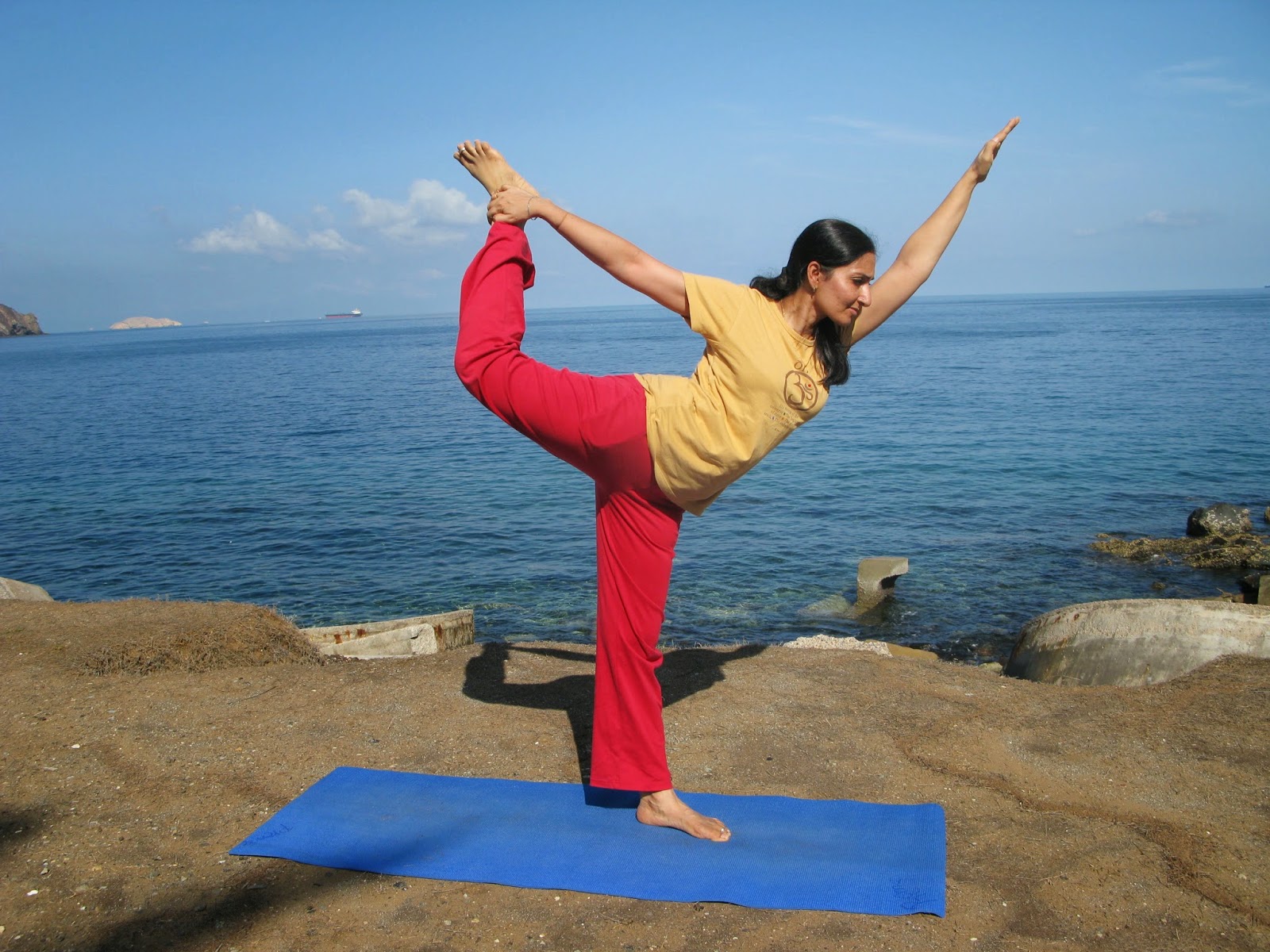
Santulasana followed by Natrajasana:
Stand straight with legs close to each other and gently bend your right leg and hold you right ankle with right hand.keep your arm straight and the other arms raised up close to the ear. stand straight and once able to focus with your eyes opened then close the eyes and balance which involves total focus and more awareness in the part of the body which is grounded.

Once your are able to focus and hold for longer ,up to 20 secs or more then slowly shift to Natrajasana (the third picture in the post).

Once you are able to perform simple one with ease then go for advanced postures,
                 

These are few examples.You can try most of the balancing postures closing the eyes which will help not only for adults to focus and improve concentration  but also for kids in their studies.Try it.

Hari om Tat Sat


Sunday, May 25, 2014

Yoga and Depression

Yoga and Depression
Sometimes its easy to get overwhelmed, its easy to feel low and alone, we all have days like that, for the lucky ones with a positive outlook, this days are few and far in between, but what about the rest of us? What happens when these days are numerous and sometimes stretch for weeks? It’s easy to dismiss this as just a phase and hope the problem will go away but what about the effects this ‘phase’ has on your body in the meanwhile?
The body and mind are intricately intertwined as in what changes good or bad is enforced on one with have a similar outcome on the other, so a simple feeling of prolonged sadness would cause increased aches and pains, weight gain or loss, insomnia and as a result overall fatigue.
The sad part is that the solution is both easy and difficult, as when one feels low a lethargy sets in which in turns effects ones breathing which is cause of so many problems, so the simple solution would be to move even more , but how does one do so when the mind is working against itself?
 This is where yoga can help
-          One of the main benefits is the excess amounts of oxygen one takes in during the many practices of yoga, this in turn invigorates the circulation system thus stimulating your body out of its inertness

-          Due to the focus one needs to maintain the balance during pro the mind immediately stops focusing on the troubling thoughts thus allowing itself a break from the pain thus elevating ones mood and increasing its focus on the body

-          Yoga also helps one feel a sense of accomplishment, after all its takes a lot to maintain your balance in that one position for as long as possible

-          It helps you grow spiritually, hard as it may sound yoga helps one connect to the spiritual sides of life thus allowing one to takes things a little bit easier thus reducing ones anxiety


Here are a few basic yoga postures that helps:

First I would suggest Suryanamaskaras with right breathing.More you do more active your body becomes.To know more about how to perform check in my blog titled "Suryanamaskaras a health tonic".
Just to be careful if one has not learnt yoga before then learn from the proper teacher so that you don't harm yourself by just blindly following what is mentioned in blog.
There are many of them now a days suffering from combination of problems like diabetes and low back and neck complaints.In that case though Suryanamaskaras are good  for  diabetes but not to be practiced initially, for other health issues mentioned. I would suggest one must go slow taking in to consideration each problem at a time giving priority to certain problem.In this way one can get rid of health issues if any, in a slow process but confidently.


Ushtrasana-Practice with one arm then slowly both arms together. Hold for 10 secs during exhalation.Repeat  thrice.


Sarpasana: Practice for  1 min twice a day


Practice Chakrasana from the floor and hold it for 10 secs and repeat three times .
Just to mention above asanas are not to be done by people suffering from hernia and uterus prolapse.
They can practice Nadishodhana Pranayama.To know more in detail please check the post"Nadishodhna"in my blog.


                                                           HARI OM TAT SAT

Thursday, November 21, 2013

YOGA FOR UTERUS PROLAPSE

The uterus (womb) is normally held in place by a hammock of muscles and ligaments.

The uterus, or womb, is said to be prolapsed when it has moved downward from its normal position. This can happen when the tissues that normally support the uterus - the pelvic floor muscles and ligaments - become stretched and weak. The uterus drops down the vagina closer to the vaginal opening, occasionally even protruding through it. The bladder and bowel can also drop down.
This condition is very common, and while it may not necessarily cause symptoms, a prolapsed uterus (also called uterine prolapse) can affect a woman's physical and sexual activity as well as her quality of life.
Causes of prolapsed uterus:
·        Childbirth, which is probably the single biggest risk factor for developing a uterine prolapse. This risk is increased if the baby was large;
·        Deterioration of muscles, that occurs with age;
·        Increased pressure within the abdomen, which often occurs with constipation, chronic cough and frequent heavy lifting. The risk is increased by conditions such as overweight and obesity;
·        An inherited tendency to weakness in the ligaments and other connective tissues.
Symptoms of prolapsed uterus:
·        The most common symptom of uterine prolapse is the awareness of ‘heaviness in the vagina  and a sensation of 'something coming down'. Sometimes women can feel a distinct lump or  bulge in her vagina or even have tissue protruding through the vaginal opening. There is often  associated backache;
·        These symptoms usually improve when lying down and are less noticeable in the morning,  getting worse during the course of the day or after exertion;
·        Uterine prolapse may also cause urinary problems such as difficulty passing urine or  emptying the bladder completely, problems holding urine or frequent urinary tract infections. It  might also cause discomfort or pain during sexual intercourse. Occasionally, it can also  interfere with bowel movements.
As a preventive measure for healing:
·        If one wants to prevent from this kind of complication throughout their life, and other similar complication like weak bladder control or umbilical hernia, then one must practice floor exercise everyday esp. related to toning the abdominal muscles and which in turn takes care of the organs;
·        Keep your weight in the normal range;
·        Practice pelvic floor exercises;
·        Avoid constipation and straining with bowel movements;
·        Avoid heavy lifting; and
·        If you have a lung problem then use your preventive and treatment medicines to limit coughing.

As a therapeutic approach:
·        If the condition is worse then one shouldn’t stretch their body backward rather perform inversions with the support of wall and later on certain crunches carefully under guidance.
Sahaj viparitakarni:

·        Lie down on your back and go closer to the wall till you are comfortably placed.
·        Raise your legs and place it on wall with heels on it.
·        Keep your legs straight
·       Now practice ujjayi breathing, with every inhalation gently let the stomach come up and exhalation let it go down but in a ratio of 1:2 of inhale and exhale and in a min 4 to 6 breaths.
·    While exhaling slowly pull your stomach in and upwards by contracting the anus muscles.
·        Practice 100 breaths.
·        This practice involves moolabandha.

Setubandh asana:


  •     lie down on back and bend you legs.
  •     Arms beside you legs and touching your ankle.
  •    While inhaling gently raise you low back and start contracting your anus and low back muscles and maintain the posture till you exhale.
  •     Inhale while exhaling release the pose.
  •     Repeat it 4 to 5 times
  •     Practice three times a day before food.

Ek pada uttanaasana:


·        Lie on your back with your legs close to each other and straight;
·        Hands beside your legs relaxed
·   While inhaling raise your left leg just parallel to the floor and exhaling hold the posture and start pulling your stomach in and up wards while contracting anus.
·        Maintain till you finish exhaling slowly place your left leg on floor while inhaling.
·        Repeat the same with the other leg too.
·        Repeat 5 times each leg.


Ardh Naukasana or Poorna Naukasana


·        Lie down on back with legs straight.
·     While inhaling slowly raise one leg up to 45 degrees angle and while exhaling raise your head and shoulders up and your hands reaching up to the knees or above while maintaining it.
·      While exhaling slowly contract your stomach muscles and lock your anus muscles too.
·        Maintain the pose till you exhale then release the pose  inhale while exhaling .
·        Repeat 5 times each leg but make sure your neck is not strained.


Lying on back Natraja pose:


·        Lie down on back with legs straight.
·        Keep your arms sideways with palm on floor
·        Inhaling raise your left leg up and hold it with right hand the left big toe
·        Exhaling gently bring it towards right side up to shoulder level.
·        Hold it for 20 secs and repeat the same with the other side.
·        Repeat three times each side.
·        One can practice this with the help of props with both their legs locked either under the sofa or chair so that legs are straight and doesn't move.
·        You can ask someone else to help you out in s stretching.
·        All the above has to be practiced three times a day for quicker results.

·        Once you feel better then you can start with more advanced ones to strengthen the back and abdominal muscles.Senior citizens can practice these asanas easily esp with the support of wall and Ardhnaukasana and other asanas mentioned here. Some of them have weaker bladder control, it would be effective in those cases too. But practice sincerely and religiously twice a day atleast.

    If a person suffers from uterus prolapse or hernia problems then they should first follow the simple one showed here the legs against the wall and practice right breathing and Moolabandh techniques everyday 100 Moolabandha then go for Setubandh asana, one leg lift then Natrajasana then for Naukasana as all these postures shouldn't be done mechanically but with full awareness of right breathing and controlling the exhalation and locking the energies at right place so that the problem is corrected. 
For more details regarding therapy please go through our website"yogatherapy4all.com"

Sunday, October 13, 2013

YOGA FOR MIGRAINE

Headache is the most common symptom a doctor is asked to treat apart from common cold. There are different types of headache and the origin is slightly different from each one.

Causes
1.      Hypertension 
2.      Muscular spasm in neck due to sedentary life style or injury to neck due to accident.
3.     Strain in eyes.
4.     Emotional or mental stress
5.     Sinus block
6.     As premenstrual syndrome
7.     Exposure to sunlight
8.     Depression
9.     Among children striving for academic excellence as well as emotional stress related to family, school, or friends
11.  There are some causes of headache which should be treated by medical experts e.g.: meningitis or acute fever, tumors
Migraine can be the effect or the results of any of the above causes too.
Migraine: 
A migraine is a debilitating 
pain in head that is often preceded or accompanied by sensory warning signs such as flashes of light, blind spots, tingling in the arms and legs, nausea, vomiting, and increased sensitivity to light and sound. The excruciating pain that migraines bring can last for hours or even days. 
It’s most common form of headache due to various reasons. According to my studies alternative therapies are working well in getting rid of this disorder.

Whatever the causes are the techniques are very similar in yoga and few variations in techniques to suit the needs eg:  due to depression, premenstrual syndrome, sensitive neck or sinus headache .There is hundred percent success rates in practitioners within 6 months to 1 year.
It’s more common in women than in men according to the research done.

 Headache remedies include various types of pain relievers. Migraine treatments may also include anti-nausea drugs and medications to prevent or stop headaches.
Most of the yogic treatments for headaches are same except few changes here and there in Asanas and Pranayamas .

Let’s discuss more yogic way of dealing the migraine which surely helps one to get over their problem however long they have been suffering from.
They need to analyze their lifestyle and find out the actual cause and if finding it difficult, then one need to go gentle and in an introspecting way of eliminating and applying certain techniques very religiously so that one can find the actual root cause of it.
Steps to treat yourself  in times of attack AND as a therapy daily to heal yourself completely in long run are:

Shashankasana

         ·     To begin this pose, you should first assume Vajrasana. Both your palms      should be placed on your knees. Keep your knees apart, so that your abdomen is in between your thigh.
·        Keep your neck and spinal cord straight.
·        Shut your eyes and begin focusing on your breathing and your body. 
·        Take a deep breath and raise your arms up slowly exhale and reach down to touch the ground with your head and both your hands. Do not lift your lower body up.
·        Relax when the forehead and palms touch the ground.
·        Do not hang your neck or stretch but keep it relaxed and back straight and stretched forward.
·        Practice it for 10 mins without any short breath and keep following your breath.

Practice Mahasirs Mudra for migraine or headache for 15 mins or along with pranayama.


 Bhramari
·        Bhramari is practiced in either sitting on chair or on the floor by keeping your back straight with the support of wall so that there is less of strain in back and neck.
·        Close your ears with your thumb and eyes with other four fingers gently.
·        No external sound is heard and no external light disturbing you.
·        You have to inhale for 3 secs or more and while exhaling only the humming sound should come without opening of mouth for 12 secs or more. Try increasing the ratio of inhale and exhale and practice 21 times in 10 mins.


Nadishuddhi pranayama
·        First practice inhale through your left nostril for 3 secs or more then exhale through your right nostril for 6 secs or more. Practice for 5 to 10 mins.
·        One round is left inhale, right exhale and right inhale, left exhale in the ratio of 1:2 .
·        Practice in a min not more than 2 to 3 rounds .
·        This has to be repeated 15 mins during the pain and thrice a day esp once before sleep at night and in the morning as soon you are awake.


ASANAS  (to be practiced daily to prevent migraine or headache and not during the attack)
Greeva Sanchalan (Neck movements)
·        Stand straight with legs close to each other.
·        Lock your arms behind with palm facing up and shoulders pushed back. Stretch your arms down.
·        While inhaling raise your chin up and look towards the ceiling. Hold this posture for 5 seconds and you can hold the breath then while releasing the posture exhale. Avoid chin down to your collarbone. Practice 3 to 5 times
·        Then inhale while exhaling turn your head towards the left hold it for 5 secs then towards the right while exhaling again and hold for 5 secs You can hold the breath for 5 seconds.
·        Awareness in the neck, arms stretched back, shoulder blades close to each and the breath.
Benefits
·        Helps you to overcome neck pain and strengthens your neck muscles.
·        If practiced repeatedly during day time after every 2 hours will prevent as well help overcome pain in neck esp. desk job persons.
·        Don’t practice more than mentioned at one sitting.
·        Has to be practiced slowly.

Skandha chakra (shoulder socket rotation)
·        Loosely place your fingers on your shoulders and arms parallel to each other and to the floor.
·        Inhale while raising your arms up allow your biceps to touch your ears and hold it for a while holding the breath for 5 counts or less if possible ,then exhale while getting it down, touch the sides of the trunk.
·        Rotate your arms slowly along with your breath.If used as therapeutic purpose it has to be repeated 5 times in a day esp when you are in a sedentary life style.
·        Awareness in the shoulders, chin up, back and the breath.
Benefits
·        Helpful in cervical problems and frozen shoulder also helps to get relieve the strain of driving and office work.
·        In turn take care of the strain caused in neck and back.

Parvatasana / Tada asana (Mountain pose)
·        Legs near to each other.
·        While inhaling raise your arms up, interlock your fingers or palm touching each or palm facing upward direction .Exhaling raise your feet up on your toes and focus on the floor. Practice normal breathing.
·        Awareness on your toes, calf, knees, stomach muscles and your breath and do not close your eyes and try maintaining the pose for 10 secs.
·        Repeat this 3 times.
·        If you are having pain in shoulders or neck do not hold more than 5 secs and repeat 5 times.
·        You can repeat this posture many number of times in a day.
·        Awareness in the feet, toes, ankles, calf muscles, knees. abdomen, arms, shoulders, chin up and the breath
Benefits
·        Spine is stretched and loosened and stretches the abdominal muscles,   intestine.
·        Beneficial for shoulder joints and those who do desk job for long hrs.
·        It’s also beneficial for those suffering from leg pain often.
·        The same posture can be done stretching on the door

Shoulder stretch
·        Legs near to each other, while inhaling raise your arms up, hold your palm, and then without releasing your arms bend your left arm sideways and bring your left elbow downward while the right elbow faces upward.
·        The left arm should be behind the head not over the head.
·        Hold it for 30 secs and then repeat the same with the other side.
·        Repeat every 1 hour for those who lead a sedentary life style of sitting in front of pc.
·        Awareness in the neck, shoulder, arms and arch in spine.
Benefits
·        Very beneficial for those suffering from neck, shoulder pain and to relax your shoulder and neck.

Sahaj Hasta Bhujangasana (simple cobra pose)
·        In Makarasana place your elbows in front of your chest, raise your arms vertically upward, placing your palm under your chin and look upward.
·        While inhaling place your elbows near to each other so that there is maximum stretch on your neck and back.
·        Exhale and can maintain this pose for even 1 min.
·        Repeat 3 to 4 times in a day and can be practiced resting your hand on table and chin on the palm.

Benefits
·        This is very useful for those having neck and shoulder pain vertigo problems.

Niralambha Bhujangasana(without support cobra pose)


  •                   Lie down in prone position with your arms beside your legs.
·        Lock your arms at the back side of your body.
·        Touch the chin on the floor and inhale raise your chin and chest up.
·        Stretch your arms backward and hold it for 5 secs.
·        Exhale and release the pose.
·        Repeat 5 times.
·        Awareness in shoulders, neck and breath.
Benefits:
·        Helps releasing the tension in neck and shoulder and mid back and takes care of vertigo.


Migraines and other types of headache -- such as tension headache and sinus headache etc -- are painful and can rob you from quality of life. You have to take care of your diet too along with right yogic way. My goal is to end the debilitating pain arising from migraine.    Meditate every day on your breath for 15 mins.

                                                                  HARI OM TAT SAT